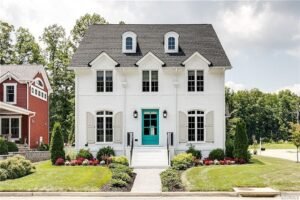


A Tampa fourplex appraises at $480,000, carries a $360,000 DSCR refinance at 75% LTV, and brings in $4,200 per month in documented market rent. At 7.75% on a 30-year fixed note, principal and interest is about $2,578 monthly. Add $700 for taxes and insurance, and the $3,278 PITIA produces a 1.28 debt service coverage ratio loan calculation ($4,200 ÷ $3,278). That leaves $922 per month before maintenance, management, and vacancy. Over five years, that is $55,320 of property-level cash flow before operating reserves, plus roughly $15,100 in principal paydown.
Investors asking, “does refinance require appraisal,” are not really asking about a $600 valuation fee. They are asking whether a valuation can cap proceeds, derail a BRRRR exit, or force a lower leverage tier. On a DSCR loan, the answer is usually yes: expect an appraisal. But appraisal alternatives and exceptions exist on select files, and the right structure depends on property type, leverage, rental evidence, and the wholesale investor’s current matrix.
By Duane Buziak, NMLS #1110647
Table of Contents
- When a refinance appraisal is normally required
- DSCR appraisal rules and leverage math
- When an AVM or desktop valuation may work
- What can lower your appraised value
- Refinance paths compared
- Eight investor questions answered
Does Refinance Require Appraisal on a DSCR Loan?
For most DSCR cash-out and rate-and-term refinances, yes. The investor funding the loan needs a defensible current value to establish the loan-to-value ratio, confirm property condition, and calculate how much equity can be released. Unlike conventional financing, DSCR underwriting centers on the property’s rent relative to its housing payment, not your W-2 income, tax returns, or personal debt-to-income ratio. That does not eliminate collateral review.
A common DSCR threshold is 1.00 or higher, meaning gross market rent covers PITIA. Better pricing and higher leverage frequently show up at 1.10, 1.15, or 1.20 DSCR, depending on the property and program. Source: Fannie Mae Selling Guide B3-3.1-08, which documents the broader industry requirement for credible collateral valuation on investment-property mortgages; DSCR programs use separate business-purpose matrices and can be materially more flexible on borrower income documentation.
At 75% LTV, the $480,000 Tampa appraisal supports a $360,000 loan. If the existing payoff is $310,000 and estimated closing costs are $9,000, gross proceeds are $50,000 and estimated net cash-out is $41,000. If the value comes in at $455,000 instead, 75% LTV supports only $341,250. The deal may still close, but cash-out falls to about $22,250 before any pricing adjustment.
That is why experienced operators order valuation early instead of treating it as a closing-week formality.
DSCR Appraisal Rules: What the Valuation Must Prove
The appraiser is not there to validate your renovation vision. The report must support current as-is value using comparable sales, account for condition, and establish market rent through a rent schedule where applicable. A clean lease helps the DSCR analysis, but it does not replace valuation.
For a renovated single-family rental in Henrico County, an appraiser may weigh three similar closed sales more heavily than an active listing with an optimistic asking price. If nearby renovated three-bedroom homes sold at $425,000, $432,000, and $440,000, a $475,000 refinance value needs real support: superior square footage, an additional bath, a premium lot, or materially better finishes.
Rental support matters too. If market rent is $2,950 but your lease says $3,400, some DSCR programs will use the lower appraiser-supported market rent. At a $2,950 qualifying rent and $2,578 PITIA, DSCR is 1.14, not 1.28. That difference can affect the available LTV tier, rate, or reserve requirement.
Current investor lending conditions are competitive, but not interchangeable. Wholesale DSCR investors are actively competing for stabilized rentals, especially clean one-to-four-unit properties with 70% to 75% leverage, 1.15-plus DSCR, and strong appraisal support. Higher-leverage 80% LTV scenarios, short-term rentals, rural properties, vacant units, or credit events can still price wider and require deeper reserves. A broker can compare multiple investor matrices instead of trying to force a real deal into one institution’s single program.
When an Appraisal Alternative May Be Available
An appraisal waiver is never something to assume on an investment property refinance. Some programs may permit an automated valuation model, desktop valuation, drive-by product, or prior-appraisal review under narrow conditions. Usually, the property must be stable, the requested leverage must be conservative, data confidence must be high, and the investor must approve that specific option.
A lower-cost valuation can be useful when speed matters, but it has a trade-off. If the model returns a lower value than expected or the investor’s review flags inconsistent data, the file can still move to a full appraisal. Investors pursuing a 7-to-10-day DSCR closing should not build their contract or payoff strategy around a waiver that has not been issued.
A soft credit pull mortgage prequalification can happen before valuation is ordered. That gives you a no hard inquiry mortgage pre approval conversation around target loan amount, estimated rent, LTV, reserves, and exit strategy without creating a hard inquiry. It is not a final approval, but it is the right first move when you need to know whether a refinance is worth pursuing.
Refinance Options Compared for Investors
| Decision point | Full appraisal DSCR refinance | AVM or desktop DSCR option | Conventional investment refinance |
|---|---|---|---|
| DSCR lender access | Broadest wholesale investor access | Limited to eligible matrices and data confidence | Agency-driven underwriting and personal-income review |
| Typical leverage tiers | 70%, 75%, and select 80% LTV tiers | Often conservative, commonly 65% to 70% LTV | Varies by occupancy, units, credit, and borrower profile |
| Rate and leverage trade-off | Higher LTV can mean higher rate or reserve needs | Lower cost may come with less cash-out | Potentially strong pricing, but documentation can be heavier |
| Close speed | Often driven by appraisal turn time | Can be faster if accepted immediately | Commonly slower with income and asset documentation |
| Best fit | Cash-out, BRRRR stabilization, and maximum supported proceeds | Low-leverage stable rental refinances | Investors with qualifying personal income and patience |
Protect the Value Before the Appraiser Arrives
The appraisal is a negotiation with evidence, not an argument after the report is completed. Provide a concise property package: renovation scope and invoices, before-and-after photos, signed lease, rent roll if applicable, and your best closed-sale comps. Do not send a stack of active listings and call it market proof.
For BRRRR operators, timing matters. A property refinanced immediately after rehab may have limited comparable sales support for the new value. Some DSCR investors accept a delayed financing structure or a seasoning exception, while others want title seasoning, a completed lease, or a documented stabilization period. Fix & Flip, ground-up construction, and multifamily operators should plan the permanent DSCR refinance during acquisition, not after capital is already trapped in the deal.
Reserves are another overlooked part of the refinance equation. A typical request may be six months of PITIA, while higher-balance loans, lower DSCR, or cash-out files can require nine to 12 months. On the Tampa example, six months of $3,278 PITIA equals $19,668 in reserves. The exact requirement depends on the investor, but it should be underwritten before you spend money on an appraisal.
FAQ: Does Refinance Require Appraisal?
1. Does every DSCR refinance require an appraisal?
Most do. Limited AVM, desktop, or waiver options may exist for lower-leverage properties that meet a specific investor’s eligibility rules.
2. Can I refinance a rental using only the lease?
No. A lease helps establish rental income, but the investor generally still needs a current valuation to determine LTV and collateral eligibility.
3. What appraisal value is needed for 75% LTV on a $360,000 loan?
You need at least a $480,000 appraised value because $360,000 divided by 0.75 equals $480,000.
4. Can a low appraisal kill a cash-out refinance?
It can reduce cash-out or require a lower loan amount. A strong DSCR ratio may preserve eligibility, but it does not override LTV limits.
5. Does DSCR use actual rent or market rent?
It depends on the program. Many use the lower of lease rent and appraiser-supported market rent, while others have specific short-term-rental rules.
6. Is an appraisal required for a no credit hit mortgage application?
Not at the prequalification stage. A soft pull mortgage broker can review the scenario first; valuation is ordered once you choose to proceed.
7. How much does a rental appraisal cost?
A typical one-to-four-unit appraisal often runs roughly $500 to $900, with complex, rural, or small multifamily properties costing more.
8. Can an LLC refinance with a DSCR loan?
Often yes. LLC-friendly structuring is a core advantage of business-purpose investment property financing, subject to vesting, guarantor, and investor rules.
A refinance appraisal is not a hurdle to fear. It is the number that tells you whether your equity, rent, and leverage can fund the next acquisition. Build the file around that number early, and your refinance becomes a portfolio decision rather than a last-minute surprise.
Legal disclaimer: This material is for educational purposes only and is not a loan approval, commitment to lend, legal advice, tax advice, or investment advice. Loan terms, rates, valuation requirements, DSCR thresholds, reserve requirements, and eligibility vary by property, borrower, state, and wholesale investor and may change without notice. Business-purpose DSCR financing is subject to underwriting approval.
Duane Buziak, Mortgage Maestro | NMLS: 1110647 | Licensed in VA · FL · TN · GA · DC | UWM PRO ELITE 2025 | UWM Top 20 Purchase LO Virginia 2025 | UWM Speed to Close Industry Leading 2025 | Scotsman Guide Top Originator 2025 & 2026 | VA Broker of the Year 2024-2025 | Top 1% Nationwide | Coast2Coast Mortgage | DuaneBuziakMortgageMaestro.com | duane@coast2coastml.com | (804) 212-8663