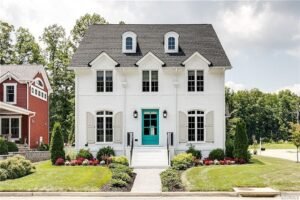


A Richmond duplex bought for $400,000 with a $300,000 DSCR loan at 75% LTV can produce a clear answer fast. At 7.75% on a 30-year fixed term, principal and interest are about $2,149 per month. Add $550 for taxes and insurance, and the qualifying housing payment is $2,699. With documented market rent of $3,400, the debt service coverage ratio is 1.26 ($3,400 divided by $2,699), leaving $701 monthly before maintenance, vacancy, management, and capital expenditures. Over five years, that is $42,060 in gross pre-expense cash flow, before rent growth or appreciation. DSCR versus portfolio loans becomes a real decision when that property is deal number one today and part of a five-property plan tomorrow.
Duane Buziak, NMLS #1110647, sees this distinction every day: one loan qualifies the asset on its rent, while the other may finance several assets through a relationship-based structure. Neither is automatically better. The right answer depends on leverage, how quickly you need to close, whether you are buying in an LLC, and how much flexibility you need for the next acquisition.
Table of Contents
- The core difference between DSCR and portfolio loans
- DSCR versus portfolio loans by numbers
- When a DSCR loan wins
- When a portfolio loan can make sense
- Current investor lending conditions
- Eight investor questions answered
The Core Difference Between DSCR and Portfolio Loans
A DSCR loan is business-purpose investment property financing built around the property’s ability to cover its debt. Instead of qualifying primarily from W-2 income, tax returns, and personal debt-to-income ratios, the underwriter reviews market rent or executed lease rent against the proposed principal, interest, taxes, insurance, and association dues when applicable. That is why DSCR is often the cleanest path for an investor using an LLC, growing beyond conventional financing limits, or holding income that does not read neatly on a tax return.
A portfolio loan usually means a loan held or structured around a broker’s wholesale investor or a depository institution’s own portfolio guidelines, rather than sold into a standard agency channel. It may cover one property, several properties, or a blanket of collateral. The term gets used loosely, which causes confusion. Some portfolio programs are still asset-based DSCR loans. Others lean heavily on global cash flow, liquidity, personal guarantees, existing deposit relationships, and cross-collateralization.
The practical difference is control. A DSCR broker can compare multiple wholesale investors and match the deal to the property profile. A traditional portfolio relationship may have one credit box, one appetite, and one committee. That relationship can be valuable, but it can also create friction when the next deal does not fit.
DSCR Versus Portfolio Loans by Numbers
| Decision point | DSCR loan | Portfolio loan |
|---|---|---|
| Qualification focus | Property rent compared with PITIA, often 0.75 to 1.25+ DSCR depending on leverage | May include property cash flow, borrower liquidity, global income, and existing relationship strength |
| Lender access | A broker can compare multiple DSCR wholesale investors and guideline overlays | Usually one institution or one credit committee’s program |
| Typical leverage tiers | Up to 80% LTV on many stabilized purchases, with select scenarios reaching 85% to 90% | Often 65% to 75% on blanket or relationship structures, depending on collateral and liquidity |
| Rate and leverage tradeoff | Higher LTV, lower DSCR, short-term rental income, or cash-out generally means a higher rate | Potentially sharper terms for strong relationships, but lower leverage or more collateral may be required |
| Close speed | Commonly 7 to 10 business days with appraisal, insurance, entity documents, and reserves ready | Often 21 to 45 days when committee review, cross-collateral, and financial analysis are involved |
| Reserves | Often 3 to 12 months of PITIA, scaled by credit profile, property count, and loan size | Frequently 6 to 12 months, plus stronger liquidity expectations across the full portfolio |
The $300,000 duplex example illustrates why small changes matter. At a 1.26 DSCR, the property clears a common 1.20 threshold. If rent is revised down to $3,100, the ratio drops to 1.15. That may still work at 70% or 75% LTV, but it can reduce leverage, increase rate, require additional reserves, or push the file to a different DSCR investor. The asset is still the asset. The structure changes.
For a Tampa single-family rental valued at $500,000 with $3,900 monthly market rent, an investor targeting 80% LTV needs to respect that math before writing the offer. A $400,000 loan at 8.00% has roughly $2,935 in principal and interest. With $650 for taxes and insurance, PITIA reaches $3,585, producing a 1.09 DSCR. That may be financeable, but not necessarily at the same pricing or leverage as a 1.20-plus file.
When a DSCR Loan Wins
DSCR is built for speed and repeatability. If you are acquiring a stabilized rental, refinancing a completed BRRRR, or pulling cash out of a seasoned property, the underwriting conversation stays centered on rent, value, leverage, credit, and reserves. Personal income still matters in some programs, but it is not the center of the approval.
This is especially useful for investors who reinvest most taxable income, own property through LLCs, or want to preserve conventional mortgage capacity for a primary residence. A soft credit pull mortgage prequalification can establish likely pricing, leverage, and reserve requirements without a hard inquiry at the beginning. That is materially different from a no-credit-hit promise. A soft pull mortgage broker can review the profile first, but a hard inquiry may be required once you choose a program and submit the full loan file.
DSCR also fits an investor’s sequence of capital. Use a Fix & Flip loan for acquisition and renovation, stabilize the asset with a tenant, then refinance into a DSCR loan. For a BRRRR operator, the permanent loan is what determines whether the recycled capital is truly available. For ground-up construction and multifamily, the same relationship matters because the exit strategy, projected rents, lease-up timeline, and reserves must work before the initial financing closes.
When a Portfolio Loan Can Make Sense
A portfolio structure is worth examining when the collateral itself creates value. An investor with eight free-and-clear rentals may prefer a blanket loan to access capital across the group rather than placing a separate lien on each property. A borrower with substantial deposits, strong liquidity, and stable business income may also receive consideration that a pure DSCR matrix does not capture.
The tradeoff is usually flexibility. Cross-collateralization can make it harder to sell one property without a release calculation. A 70% blanket LTV may look conservative until you realize it ties up equity across several properties. Ask whether there is a partial-release formula, a prepayment penalty, a minimum debt yield, and a requirement to maintain deposit balances. Those details can matter more than a headline rate.
For a five-plus-unit multifamily property, portfolio or commercial execution may be necessary depending on the asset and loan size. It can be the right lane, but investors should expect a deeper review of trailing income, expenses, occupancy, and sponsor liquidity than a one-to-four-unit DSCR file.
Current Investor Lending Conditions Favor Prepared Files
Investor capital remains available, but rate sheets are selective. Stabilized long-term rentals with 1.20-plus DSCR, 75% LTV or lower, 720-plus credit, and six months of reserves usually draw the strongest appetite. Files become more expensive as leverage rises toward 80% to 85%, DSCR moves below 1.00, or the property depends on inconsistent short-term rental income.
Competition for clean properties is still fast, particularly in growth corridors across Florida, Tennessee, Georgia, and Virginia. The investor who has rental comps, insurance quotes, entity documents, bank statements, and reserve funds organized can often compete more effectively than the investor chasing a lower advertised rate without a viable approval path. Typical DSCR closing costs commonly run about 2% to 5% of the loan amount, including third-party items, title charges, prepaid items, and program costs. Request a written estimate early because points and prepayment structures vary by investor.
FAQ: DSCR and Portfolio Loans
1. What DSCR do I need for a rental loan?
Many programs target 1.00 to 1.25 DSCR. Some allow ratios below 1.00 with lower LTV, stronger credit, more reserves, or rate adjustments.
2. Can I buy through an LLC?
Yes. DSCR financing is commonly LLC-friendly, though a personal guarantee is often required.
3. Is a portfolio loan always cheaper?
No. A strong relationship can help, but lower leverage, deposit requirements, or cross-collateralization may offset a lower note rate.
4. Can DSCR loans close in 7 to 10 days?
They can when the appraisal, title, insurance, entity documents, lease or rent schedule, and reserves are ready. Complex files can take longer.
5. Do I need tax returns for a DSCR loan?
Often not for income qualification. Credit, assets, property documents, and entity information are still reviewed.
6. Can I refinance a BRRRR with DSCR?
Yes. Once the renovation is complete and the property is stabilized, DSCR cash-out or rate-term refinancing can provide the permanent financing exit.
7. Are reserves required?
Usually. Plan for 3 to 12 months of PITIA, with higher requirements possible for larger portfolios, lower credit, or higher leverage.
8. Can a soft pull protect my credit before I apply?
A mortgage pre approval without hard pull can be used for an early scenario review. A full application may later require a hard credit inquiry.
The best financing is the structure that leaves you able to buy the next deal without trapping equity in the last one. Run the rent, debt, reserves, release terms, and exit strategy before you let a rate quote make the decision.
Legal disclaimer: This article is for general educational purposes only and is not a commitment to lend, an approval, legal advice, tax advice, or investment advice. Loan terms, rates, eligibility, reserves, property requirements, and closing timelines vary by program, borrower profile, property type, and market conditions. Business-purpose financing is subject to underwriting and applicable licensing requirements.
Duane Buziak, Mortgage Maestro | NMLS: 1110647 | Licensed in VA · FL · TN · GA · DC | UWM PRO ELITE 2025 | UWM Top 20 Purchase LO Virginia 2025 | UWM Speed to Close Industry Leading 2025 | Scotsman Guide Top Originator 2025 & 2026 | VA Broker of the Year 2024-2025 | Top 1% Nationwide | Coast2Coast Mortgage | DuaneBuziakMortgageMaestro.com | duane@coast2coastml.com | (804) 212-8663